Context Switch Changes The Process Mode From
This means switching the memory address space. During a context switch the operating system can do additional work that isnt strictly part of the context switch.

What Is Context Switching In Operating System
Context Switching is the characteristic of a multitasking operating system.
Context switch changes the process mode from. In computing a context switch is the process of storing the state of a process or of a thread so that it can be restored and execution resumed from the same point later. This means switching the memory address space. Change the active page tables.
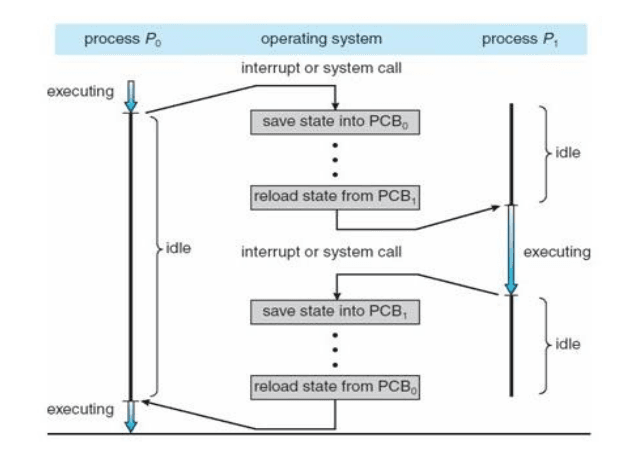
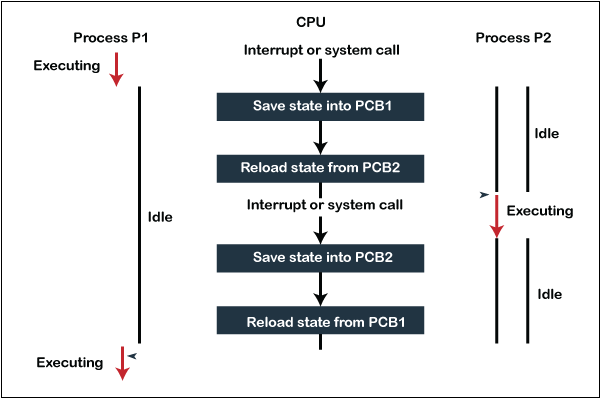
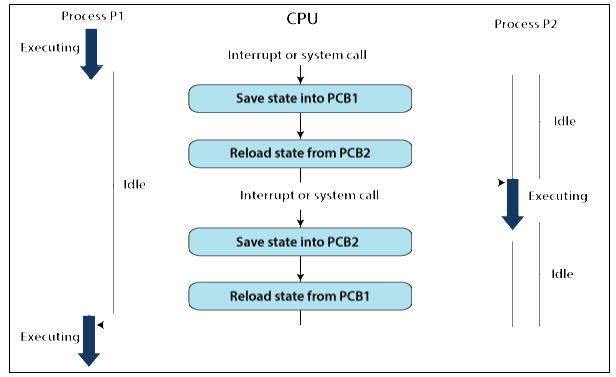
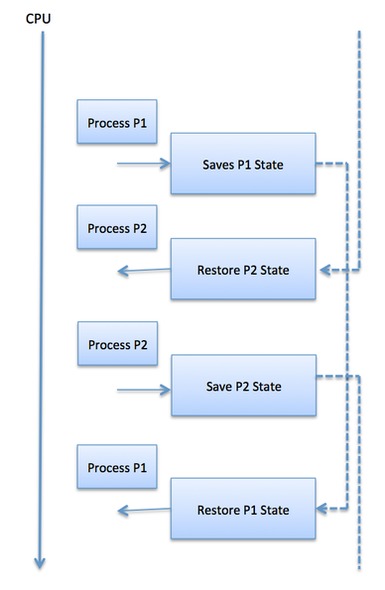
After some time again a context switch occurs and Process 2 is switched out and Process 1 is switched in again. It involves switching of all the process resources with those needed by a new process. There are two situations that can result in a context switch.
Restored on a context switch between threads in the same process. Now system calls are very different wrt. Process-speci fic state such as the PCB file-de scriptor table etc is usually.
D None of the mentioned. B Kernel switches from executing one process to another. And then the scheduler needs to point the MMU to the new processs memory map which still requires elevated privileges.
False after finishing its job in kernel mode the OS may sometimes decide to go back to the. The kernel makes a context switch by pushing context information onto the current kernel mode stack for a process it also saves the address of its page table directory so that its address space is maintained. The context Set User-Mode Address Context command has a similar effect.
This may be assisted by hardware. A Kernel switches from executing one process to another. A process can access IO Hardware registers to program it can execute OS kernel code and access kernel data in Kernel mode.
Newsaved SPsaved PC Ps kernel stack. A context switch also sometimes referred to as a process switch or a task switch is the switching of the CPU central processing unit from one process or thread to another. Context Switching is the switching of CPU from one process to another process.
C Process switches from kernel mode to user mode. A mode switch occurs when a process requires accessing a system resource. The precise meaning of the phrase context switch varies.
The timer interrupt routine invokes the scheduler moduleMOD_5 to perform a context switch. Process switches from kernel mode to user mode. Process 1 is switched out and Process 2 is switched in because of an interrupt or a system call.
C Process switches from user mode to kernel mode. Process Switching. This includes memory addresses page tables and kernel resources caches in the processor.
It involves switching of all the process resources with those needed by a new process. A context switching is a process that involves switching of the CPU from one process or task to another. Mode switch changes the process privileges between user and kernel modes.
Consider something simple for example the system call for requesting. This allows multiple processes to share a single central processing unit CPU and is an essential feature of a multitasking operating system. - change PU ring setting - find system call entry point-set up kernel stack PC SP OS yield pid_t old new.
This includes memory addresses page tables and kernel resources caches in the processor. Kernel switches from executing one process to another. A process undergoes a context switch every time it enters kernel mode from user mode.
Process switching is a type of context switching where we switch one process with another process. In computing a context switch is the process of storing the state of a process or thread so that it can be restored and resume execution at a later point. A process also sometimes referred to as a.
Process switching is a type of context switching where we switch one process with another process. B Process switches from kernel mode to user mode. The time slice of a process executing in the user mode expires and a timer interrupt is raised.
What is a context switch. The scheduler needs to access the process table and the next processs memory map both of which are not accessible to the old process and therefore require privilege elevation. On an x86-based processor context and process have almost the same effect.
It happens using the system call interface or by an interrupt. In its life span a process executes in user mode and kernel modeThe User mode is normal mode where the process has limited access. 53 The maximum time slice that can be given to a process in Linux where tick is 10ms is.
Transition to kernel mode. A context switch between processes always involves entering supervisor mode at the processor level. Context Switch Definition.
D Process switches from user mode to kernel mode. In addition when switching between threads in different processes the memory protection state must be switched ie. Context switching involves saving the state of Process 1 into PCB1 and loading the state of process 2 from PCB2.
What is a context switch. It has to context switch into kernel privileged mode to do things then switch back. While the Kernel mode is the privileged mode where the process has unrestricted access to system resources like hardware memory etc.
However the context command sets the user-mode address context to a specific page directory while the process command sets the process context to a specific process. One common thing is calculating the amount of time the last threadtaskprocess used so that software and the end user can determine where all the CPU time is going. When the process is typically running it is in user mode which is a non-privileged mode of operation.
Process switches from user mode to kernel mode. Thats the essence of threadprocess scheduling. A full context switch would involve swapping both of these the old current threadprocess goes away for a while and the new current threadprocess comes in for a while.
System call allows user mode process to call a. In this phenomenon the execution of the process that is present in the running state is suspended by the kernel and another process that is present in the ready state is executed by the CPU. This document specifies how stack management has to be performed during a context switch.
These questions can be attempted by anyone focusing on Linux Development and Systems programming. A None of the options. Context switching means storing the process state so that we can reload the process when needed and the execution of the process can be resumed from the same point later.

Process And Thread Context Switching Do You Know The Difference By Vikram Gupta Level Up Coding

Context Switch Youtube

Main Stack Pointer An Overview Sciencedirect Topics

Steps In Context Switching Stack Overflow

What Is Context Switching In Operating System
What Is The Difference Between User And Kernel Modes In Operating Systems Stack Overflow
What Is The Context Switching In The Operating System Javatpoint

Difference Between Swapping And Context Switching Geeksforgeeks

Difference Between Swapping And Context Switching Geeksforgeeks
Os Process Multi Programming Context Switching Long Questions Answers Examradar
What Is Context Switching Tutorial And Example

Difference Between Dispatch Latency And Context Switch In Operating Systems Geeksforgeeks

User Mode And Kernel Mode Switching Geeksforgeeks
What Is The Difference Between Mode Switch And Process Switch Pediaa Com


Context Switching In The Operating System Explained Context System Explained

Process And Thread Context Switching Do You Know The Difference By Vikram Gupta Level Up Coding

Difference Between Dispatch Latency And Context Switch In Operating Systems Geeksforgeeks
Operating System Process Scheduling
What Is The Difference Between Mode Switch And Process Switch Pediaa Com

Posting Komentar untuk "Context Switch Changes The Process Mode From"